
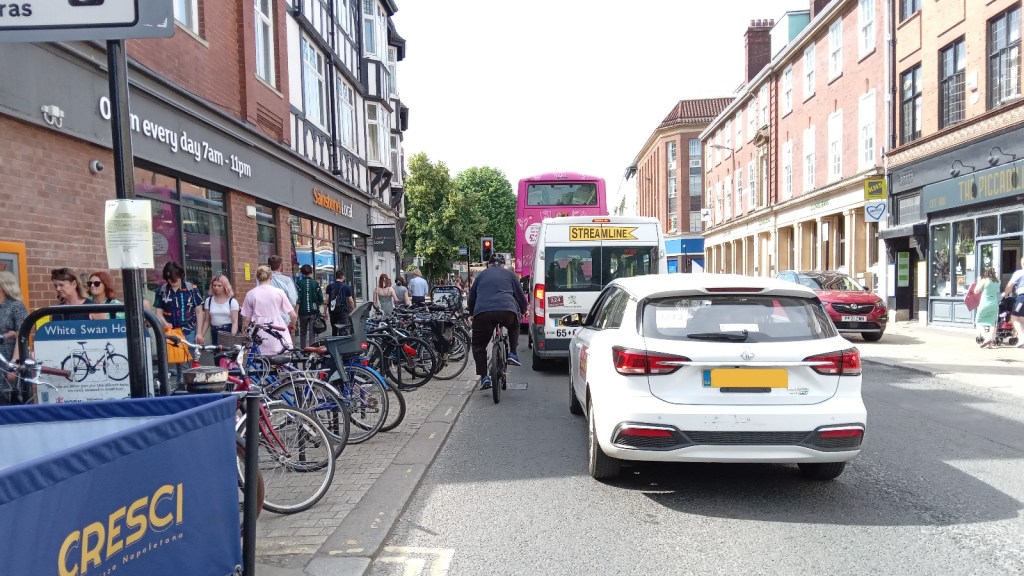
York Cycle Campaign submitted a written statement to the 12th October meeting of the Council Executive broadly welcoming the proposed Local Transport Plan (LTP), in particular the ambition to ‘improve walking, wheeling and cycling’. Several of our members spoke at the meeting. We also made oral and written submissions to the 24 October meeting of the Scrutiny Committee, outlining in more detail our responses to specific areas of the Plan. The public will be invited to respond via the Council’s Big Transport Conversation, due to go live on the 20th November and stay open for several weeks. Our 24th October statement is below.
York Cycle Campaign welcomes the additional information about the Council’s plans for the delivery of a new Local Transport Plan.
YCC wants York to have a future as a sustainable, socially equitable and economically buoyant city. YCC believes that to achieve this will require measures to dramatically increase the uptake of active travel – particularly cycling – and public transport.
We are pleased that the policy focus areas contain proposals which – if fully implemented – should enable York to achieve the much-needed increase in active travel and public transport.
In terms of transport strategy, we welcome the proposals to respect the transport user hierarchy, to move from ‘predict and provide’ to ‘decide and provide’, to embed a focus on healthy and safe streets and to adopt Vision Zero on road safety. We are pleased that there is now a clear recognition that moving to EVs is not the answer to York’s transport woes.
We strongly welcome the proposals to create a connected priority cycling network, to upgrade cycling facilities, and to re-allocate road space to cyclists. These aims – combined with measures to reduce road speeds – are vital to achieve the necessary growth in cycling. We reiterate our view that proposals that focus on culture change – whilst welcome – will not increase cycling unless accompanied by improvements to York’s cycling infrastructure.
We are, however, concerned that the more detailed proposals around the cycle network are far too modest in scale: much greater ambition will be needed to achieve the necessary growth in cycling. We are also concerned that there are some proposals that do not take adequate account of the needs of cyclists, for example there is no mention of improving cycle access into and through the city centre and the proposal around speed reduction needs to be strengthened.
As noted above, in order for the Local Transport Plan to achieve its goals, the proposals it contains – particularly those around improvements to cycling infrastructure – need to be fully implemented. Previous Local Transport plans have promised much but delivered very little. We hope that this will not be the case this time.
A great deal rests on the Local Cycling and Walking Infrastructure Plan which will set out the details of the changes to be made to cycling infrastructure. We look forward to continuing our work with the Council on the LCWIP to ensure that it is robust in its approach and ambitious in its intentions. We will then hold the Council to account in terms of its implementation.
Targets
It is vital that targets are set for cycling journeys/frequency of cycle use rather than a single ‘active travel’ target. With the right infrastructure, York could achieve Dutch levels of cycling and the cycling targets should reflect this ambition. We would also like to see a specific target for the reduction in cycling-related injuries and fatalities (rather than traffic injuries/fatalities in general).
Policy focus on accessibility
We strongly support the proposal to increase the density of cycle parking (1.2) and to develop cycle networks that can accommodate those who use non-standard cycles (1.3), including many disabled cyclists and families. Disabled cyclists are, however, currently excluded from much of the city centre and it is vital that this issue is addressed, particularly given the recent moves to re-open the city centre to Blue Badge drivers. Action to remove the numerous barriers on cycleways has been long-promised but has largely failed to materialise. We are also concerned that decisions around, for example, cycle access to footstreets and the use of bus stop bypasses, are not taking into account evidence that suggests that these initiatives can be implemented successfully without detriment to the visually impaired or other vulnerable pedestrians.
Policy focus on improving walking, wheeling and cycling
We strongly welcome the proposals to create a connected priority cycling network (2.5), and to upgrade cycling facilities (2.6). These are the essential proposals if York is to move away from car dominance to being a city where active travel is safe, convenient and accessible for residents and visitors. We also welcome the proposals around the application of the transport user hierarchy (2.1), community support (2.7) and use of e-bikes (2.8).
We are disappointed to note that the specifics around 2.5 and 2.6 appear to be far too modest in scale (one radial route and one village-York route): much greater ambition will be needed to achieve the desired growth in cycling. We look to the Council to address this as a matter of urgency.
We are concerned about the proposal (2.4) regarding the upgrading of the city footstreet network, as there is no indication of improved access for cyclists. It is vital that the footstreet network is revised to enable direct 24/7 access into and through the city centre for cyclists and we note that the evidence shows that this can be achieved without harm to vulnerable pedestrians.
Policy focus on shaping health places
We strongly welcome all the proposals, including support for local centers (3.1), embedding the healthy streets approach (3.4), safe street measures including home zones (3.5), and the adoption of Vision Zero (3.6).
Policy focus on improving public transport
We welcome the proposal to ensure that rail hubs are linked to cycle networks (4.6) and the proposal about enabling multi-modal journeys (4.7).
Policy on safeguarding our environment
We welcome the acknowledgement that moving to private EV vehicles, whilst beneficial in some ways, will not solve York’s transport problem. Instead, the focus must be on active travel and public transport (EV in the cases of buses). We welcome the proposals on green infrastructure (5.5) and environmentally friendly transport for visitors (5.8) and hope that York can become a Dutch-style beacon of good practice in this regard.
Policy focus on managing the road network for movement and place
We strongly welcome the proposal to commission a movement and place plan, including a reassessment of the inner ring road which is a significant barrier to cyclists (6.1), to address areas of conflict within the network (6.2), to prioritise active travel and public transport within the network (6.3), to recognise the needs of cyclists in the maintenance of highway assets (6.5), and to move to ‘decide and provide’ in place of ‘predict and provide’ (6.6). We also strongly welcome the proposal to adopt 20 mph as the default speed limit for all roads through residential areas, near schools, in villages and at retail areas and parks (6.4) but believe that this does not go far enough and that the 20 mph limit should be utilised more widely to promote active travel, including on York’s bridges, at the station, and on non-residential roads that are vital routes for active travel between residential areas.
Policy focus on reducing car dependency
We strongly welcome the recognition of the need to provide alternatives to car travel for those that are able to use active travel and public transport modes. We welcome the proposals to encourage active travel to school and work (7.1), to support businesses to reduce their transport footprint (7.2) and the use of campaigns, including car-free days (7.3). We note, however, that these proposals will be of limited effectiveness unless there are significant improvements in cycling provision (proposals 2.5 and 2.6).
Policy focus on improving freight and logistics
We strongly welcome the proposal to promote and support the use of cargo bikes for freight (8.2).
Policy focus on managing streetworks
We welcome the proposal to improve maintenance of cycleways (9.1).
Policy focus on monitoring and financing the changes
We welcome all the proposals. We note that with the current budgetary issues it will be challenging to deliver the change needed and the Council will need to take a significant step up in its approach to bidding for transport funding. We remind the Council that there is convincing evidence that improving cycle infrastructure is one of the most – if not the most – cost effective transport interventions.
LCWIP
We welcome the progress made with the LCWIP but are concerned that the draft cycling network that we have seen has significant flaws – in terms of gaps in the network – and is at the moment – still based on the ‘predict and provide’ model of transport planning rather than the ‘decide and provide’ model of transport planning. We look forward to continuing to work with the Council to achieve the best possible outcome for the LCWIP in order to revolutionise active travel within the City.
Big Transport Conversation
As previously noted, in our written statement of 12th October, we welcome the acknowledgement that previous consultations have been flawed, for example have asked overly detailed and leading questions and over usd technical language. We also strongly welcome the recognition of the need for consultations to counter the ‘us versus them’ division between car drivers and others, noting, for example, that the vast majority of cyclists are also pedestrians and motorists.
YCC looks forward to actively participating in the consultation process and would welcome the opportunity to work with those delivering the consultation to reach out to York’s cycling community. This might include a particular focus on marginalised or hard to reach cyclists, including those who are disabled, young, cyclists commuting into York, senior citizens, female, or from deprived and minority ethnic communities (including refugees).
We note the references to the CYC-run Bus Forum and would ask that in the absence of a CYC-run cycle forum that YCC is accorded the same level of access and involvement in the consultation process.
Air Quality Action Plan
We note that cycling can play a key role in ensuring that York meets its air quality targets. We are concerned that the consultation being proposed is flawed, and like many previous consultations does not present information in a way that helps residents to make informed decisions (for example, it asks individuals to prioritise measures without giving a simple indication – within the survey – of which measures are likely to result in the greatest improvements in air quality).
 York Cycle Campaign
Leave a comment