
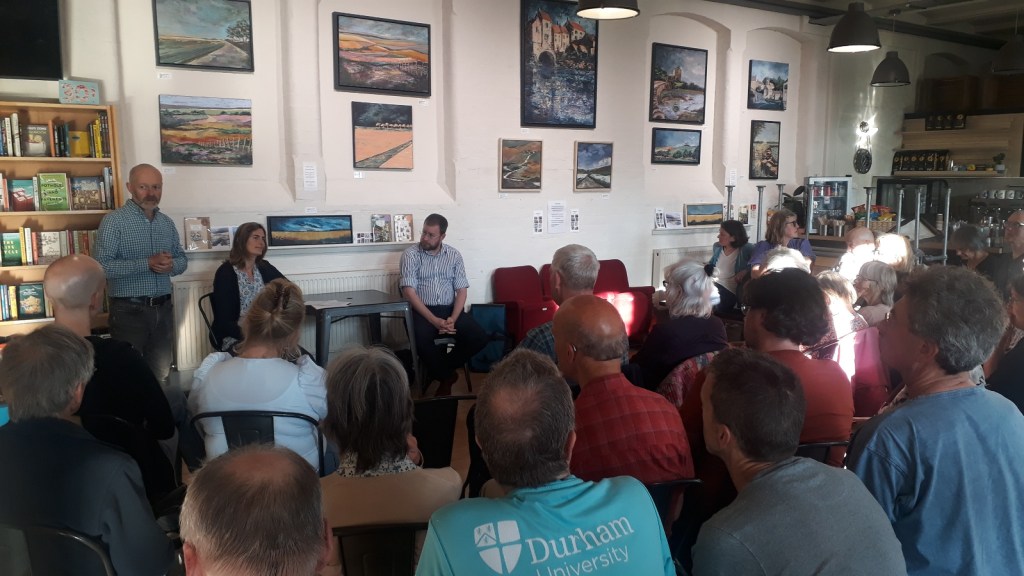
Cover image credit: Pam Hanley
On 8 July, 40 members turned out to hear from Councillor Kate Ravilious – Executive Member for Transport – and Tom Horner – Head of Active and Sustainable Transport at the Council. The focus was what’s been happening behind the scenes in the development of (a) the Local Transport Strategy and (b) the Movement and Place Plan Framework. These will be presented to the Executive of the Council later this month. In autumn, the Executive will consider how the schemes will be executed (this includes the Local Cycling and Walking Infrastructure Plan and LTS implementation plan).
In terms of the public, over 2000 people responded to the consultation on the draft plans, and over 75% of those were supportive of the ten policies proposed. The overarching vision is to move away from a vehicle-dominated city to one prioritising sustainable travel (bus, walking, wheeling and cycling), with people enjoying the journey itself as well as having coherent, well-connected routes to travel along. Kate talked about developing areas with different characteristics: residential and shopping streets; green spaces, bus routes, freight routes.
There will be a lot of work involved in the detail, for instance identifying gaps in routes that need plugging. As regards safe routes to schools (an area YCC campaigns on), Kate talked about the possibility of piloting “school streets” where vehicular access is restricted at certain times of day (such as the start and end of school). Apparently this is delayed only because there is a wait for legislative approval that will enable enforcement by putting cameras in the target streets.
Kate also addressed the challenges that the Council faces, such as finding the money for schemes, getting buy-in from the public and other political parties, and upskilling staff. She talked about potential sources of financing: Active Travel England and the new mayor of York and North Yorkshire. Furthermore, schemes would be chosen to maximise value rather than necessarily achieve the ideal at far greater cost within a limited budget. An example she gave was the prohibitive cost of supplying just one kilometre of cycle route versus introducing “bus filters” – streets which would restrict motorised traffic to buses and emergency vehicles, giving a cyclist a more pleasant experience.
One change Kate outlined was switching from the current “predict and provide” approach – anticipating how the traffic will change and providing accordingly (eg more car access) to the “decide and provide” model – what mix of traffic do we want to see, and how will we make it happen?

There was plenty of time for questions which were thoughtful and wide-ranging, covering everything from the big picture (such as the Council’s aspiration and connected travel) to the details (potholes, cycle parking and overgrown cycle paths).
Andy Shrimpton noted that many of the changes being proposed are likely to generate some vocal opposition. As cyclists and pedestrians we will all need to be prepared to have our say with our friends and colleagues and on social media to make it clear that the vast majority of York residents support a move to active travel and public transport to solve the City’s transport problems and improve health and wellbeing. Both Kate and Tom stressed that they are keen to work with YCC as representatives of the cycling community.
We will keep you updated about the progress of the plans, and any actions we think YCC members can usefully take in response.

 York Cycle Campaign
Leave a comment