
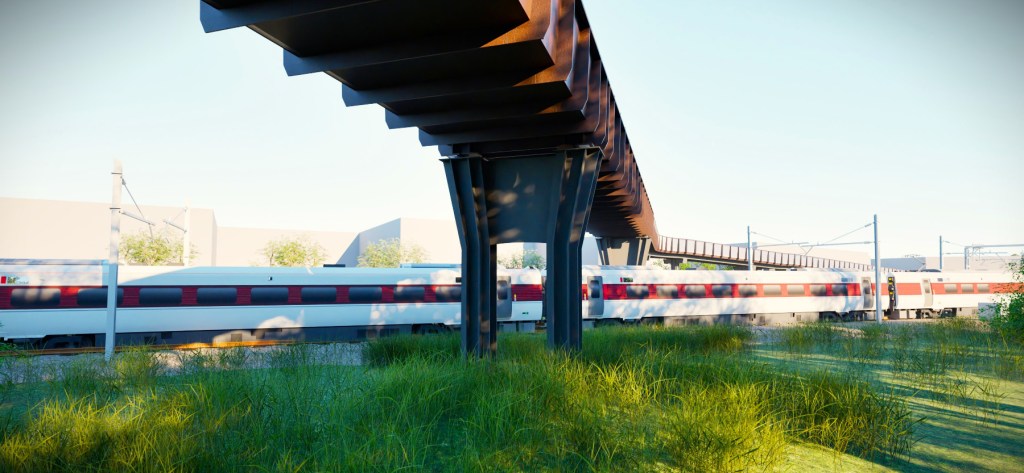
Cover image: Story Contracting Limited/MHB Consultancy/Network Rail
Network Rail have submitted a planning application to replace the existing Wilton Rise Footbridge with a new accessible bridge, the Wilton Rise Pedestrian and Cycle Bridge (WRPCB) linking Holgate and York Central.
York Cycle Campaign have submitted a response in favour of the proposals, a copy of which is included below, and we encourage all who will benefit from the new bridge to do so to.
The public consultation on this application is open until Thursday, December 18th 2025, and can be accessed on the York Planning Access site under reference 25/02252/FUL.
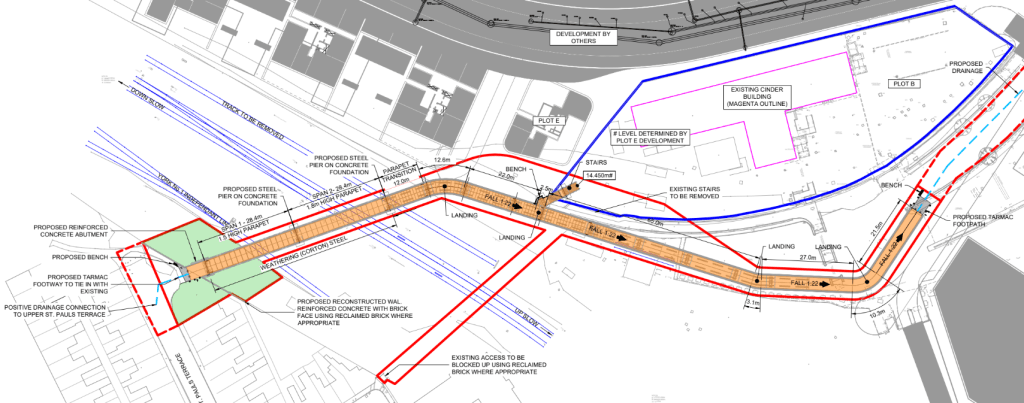
Image source: Story Contracting Limited/MHB Consultancy/Network Rail
Despite being included on council maps as part of the city’s cycle network, the current bridge is an impassable obstacle for most cyclists due to its narrow clearance and steep staircases which the wheeling ramps provide little assistance for. The new design directly resolves this, offering significant benefits for active travel:
- Step-Free Connectivity: The key improvement of the new bridge is it is completely step-free, instead crossing the railway through a series of gently graded ramps.
- Safe, Shared Space: The new bridge will feature an unsegregated 4.0-metre-wide shared-use path, similar in width to both Millenium Bridge and Hungate Bridge. This generous dimension exceeds standard recommendations, ensuring ample space for safe two-way cycle movement and reducing conflict between pedestrians and cyclists.
- Strategic Access: The new bridge will establish an accessible and convenient cycling link for Acomb and Holgate into the new York Central development, and continuing through into the city centre. This new route will provide a safer alternative to the current route Holgate Road and Blossom Street.
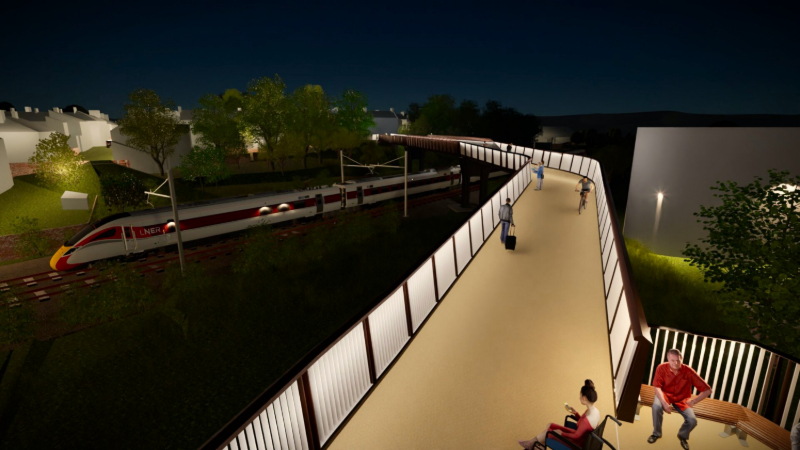
Image source: Story Contracting Limited/MHB Consultancy/Network Rail
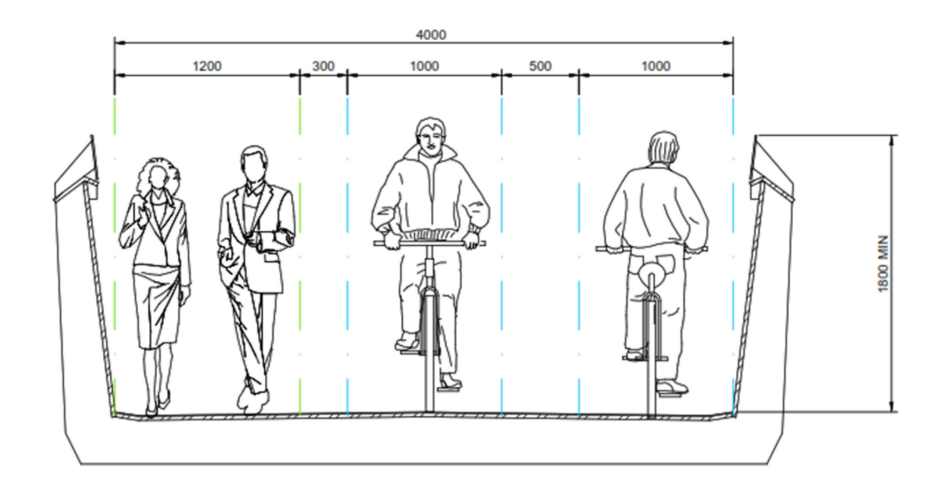
Image source: Story Contracting Limited/MHB Consultancy/Network Rail
The submitted application brings closer the realisation of one of the more anticipated parts of the York Central masterplan for many cyclists.
How the bridge will be accessed from the western side is still under consideration however, with the submitted application not covering whether a new connection will be made up Chancery Rise or if access will remain up the unadopted Wilton Rise – a road notorious for its state of disrepair.
York Cycle Campaign’s submitted response follows below;
York Cycle Campaign are writing in support of the application made by Network Rail Infrastructure Ltd, via their agent, for the construction of a new pedestrian and cycle bridge with associated infrastructure following demolition of the existing bridge between Wilton Rise to the York Central Site.
Whilst Wilton RIse and the existing cycle track on the York Central side of the railway lines are designated cycle routes, the current footbridge effectively rules out the route to all a select few who are able to carry bikes up the to flights of steep steps. The new bridge will make this route accessible to all cyclists in doing so reducing journey times towards the city centre and providing a safer alternative route to Holgate Road and Blossom Street.
Despite writing in support, the Campaign has noted some aspects it considers need further development and consideration.
Length of Gradiented Sections
Gradients on ramped sections are consistent, however the longest section of ramp exceeds the desirable maximum length given in table 5-8 LTN 1/20 for a ramp with a gradient of 4.5% (1:22) by 25m. Two of the four landings are also below the recommended 5m length recommended in paragraph 5.9.10 of LTN 1/20. Whilst the available space and difference in heights may restrict what can be achieved, it would be advantageous if the proposals could be reviewed to bring the gradients and landings in line with LTN 1/20. All other sections of ramp and landing are acceptable.
Potential User Conflict at Stairs
The stairs at the midpoint of the bridge have a narrow landing section opening up onto the main bridge thoroughfare with 90 degree corners. According to the D&A Statement the parapet is 1.5m in this section, which will prevent cyclists and pedestrians on the landing having clear views of each other. As reducing the height of the parapet would not be a safe option, a more open splay on the landing is needed to increase intervisibility between the main thoroughfare and landing.
Insufficient Bollard Spacing
The bollards placed at the ends of the bridge are declared as having 1350mm between bollards. The Design and Access statements cites this as an exceedance of BS 8300-1 requirements, however that standard is predominantly focused on the design of accessibility for pedestrians and wheelchair users not cyclists. As the route is for both pedestrian and cycle use, the more onerous minimum width of 1500m stated in LTN 1/20 (para 8.3.5) is more appropriate. This width would allow for the full range of cycles, including adapted cycles, and their kinetic envelopes. A narrower width risks excluding some cyclists from being able to use the bridge, with those with disabilities or other vulnerabilities such as parents with children being most likely to be affected.
CCTV Coverage
The form of the bridge means that it is not possible to observe its full length from one end to the other, and the vertical plates design of the parapet will limit views into the bridge other than when looked at straight on. CCTV along the length of the bridge would increase safety of all users, however the Design & Access Statement makes a single reference to CCTV in that it will be provided by others. The implementation of this CCTV should be conditioned to be in place covering the whole bridge, in line with police recommendations and BS 8418.
If completed successfully, the bridge has the potential to bring the same level of change for residents in the west of York that the Millenium Bridge did for those living in the south.
 York Cycle Campaign
Leave a comment