

Cover image: CGI of the proposed Western Station Entrance c/o York Central Partnership/3D Reid
York Central is one of the largest brownfield regeneration sites in England, and the latest planning application gives detail to apartments, houses, and the new western entrance into York Station. York Cycle Campaign have reviewed these proposals to ensure the infrastructure meets the high standards our city deserves.
From high-capacity cycle hubs to inclusive parking for non-standard bikes, here is a breakdown of what the new development promises for life on two wheels.
The Western Station Entrance & Cycle Hub
A significant part of the proposals is the introduction of a major new accessible western entrance into the station, where there are currently just footbridge steps.
A key part of this proposal is a dedicated cycle hub intended to accommodate approximately 300 cycle spaces. The internal cycle hub is accessed from a prominent entrance direct from a cycle track, although the campaign does have some concerns about the connection through the main square, and are step free from track to racks and then on to platform. Racks are predominantly two-tier type, but there are a number of racks dedicated for use by non-standard cycles and for riders with disabilities near the entrance.
Coal Drops Square: The Civic Heart
As the primary gateway to York Central, Coal Drops Square is designed as a “world-class” civic space. While it will host markets and events, it also serves as a transit point leading into the Western Station Entrance.
The space will require cyclists to dismount to access the entrance which the campaign has raised concerns about in its response, although riders who can’t will apparently be exempt from the requirement.
Residential Living: Cinder Yards & Foundry Village
Whether in the “Build to Rent” apartments at Cinder Yards or the “street-based” neighborhood of Foundry Village, the planners have adhered to a minimum 5% allocation for non-standard cycles.
Residents in apartments get secure, communal cycle stores conveniently located at ground level for easy access. Whilst for those in terraced or mews houses, cycle parking is integrated “on-plot,” utilising gardens, porches, or garages to keep bikes secure and dry.
The Verdict
Whilst there are some technical points with the designs that the campaign has picked up on and we have some concerns about the approach into the Western Station Entrance, the campaign has written in support of the proposals for putting in the infrastructure cyclists will need for York Central to be a success.
A full copy of the campaign’s response in included below.
York Cycle Campaign are writing in support of planning application ref 25/02385/REMM, covering reserved matters for Plots C3, C4, D2, E, F3. F4, and Coal Drops Square of the York Central Development.
The proposals show a commitment to creating a development that will enable residents, employees, and visitors to choose active travel by providing high quality and sufficient levels of cycle parking.
However, our review of the proposals has identified there are some aspects that aren’t fully covered in the submission documents, which we feel should be addressed as conditions attached to decision notice.
Coal Drops Square
The main approach to the cycle hub for many is likely to be approaching directly from Cinder Street through Coal Drops Square, being the most direct route from new properties in York Central and any cyclists entering from Marble Arch Tunnel. It’s also the most intuitive approach for cyclists approaching from the new Wilton Rise Bridge, being a more linear route and offering greater personal safety for not running down back routes between buildings with predominantly daytime uses.
It is therefore disappointing to see that the approach from this route does not provide provision for cycling straight to the cycle parking, and instead encourages cyclists to dismount to push through the square. It is noted that the D&A statement references that those who can’t dismount won’t be obliged to, however a lack of understanding from some members of public about the visibility of disabilities by the public and disobedience by other cyclists will likely lead to conflict between cyclists and pedestrians.
This could be avoided by continuing the two-way cycle path that runs around the back of Plot C2 up to Cinder Street across the north-eastern elevation of Plot D2, providing access to the cycle parking from either direction. This would move all cyclists safely away from the main pedestrian entrance route in Plot C3 and any activities taking place in Coal Drops Square, and provide convenient and accessible into the cycle parking.
Doors to Communal & Public Cycle Parking
The documents are unclear on the actual clear opening width of the doors that form the entrance from the street to into the cycle stores, or their mode of operation. Doors which are too narrow or that require manual effort to open and keep open will exclude certain cyclists from using them due to the size of their bike and/or their physical ability.
We recommend that a condition is applied to require all doors forming the access route from street to communal and public cycle parking shall provide a minimum effective clear opening width of 1500mm, and shall be fitted with automatic opening devices controlled by sensor, button, or access control device as appropriate.
Design of Cycle Stands
Whilst the submission documents identify that an amount of cycle stands will be provided as an alternative to the two-tier cycle racks, they do not identify details of the type and layout of these stands and how their purpose will be identified.
The proposals for the communal apartment cycle stores for Plots K & L are of particular concern as they appear to show the accessible stands placed below cycle racks. Whilst there is no official guidance to the required head height above accessible stands in LTN 1/20 or other complimentary documents, a head height of 2.0m is generally cited as the minimum head height for other purposes in documents such as Approved Documents K & M, and BS 8300. The upper tier of two tier stands are significantly lower than 2.0m which will prevent ease of access to accessible stands below especially for those with limited physical abilities for which the stands are intended for. It is also highly likely that any cycles parked in the stands at ground level will prevent the top tier racks from being accessed.
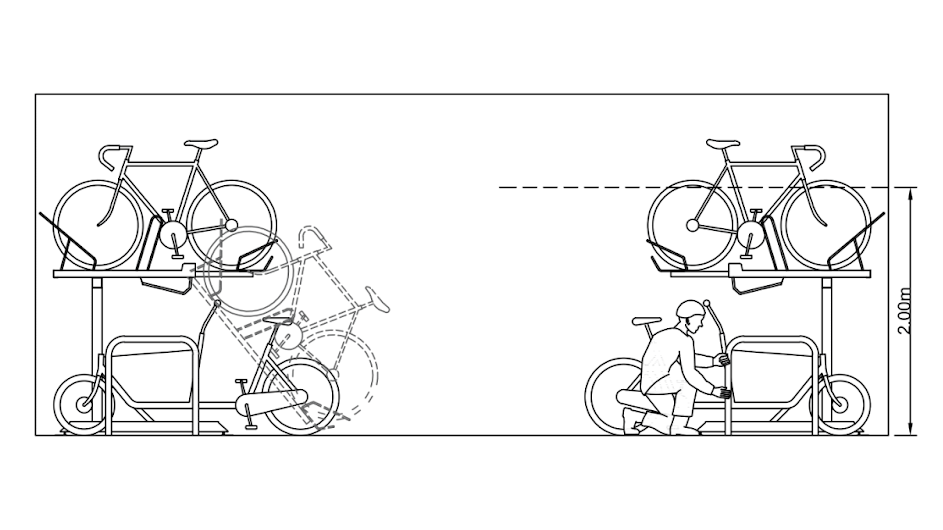
We recommend that a condition is applied that full details of the type and arrangement of the cycle stands should be submitted for approval by the Local Planning Authority, and that cycle parking shall be implemented according to those approved details prior to occupation of the plot. We also recommend that approval of those details should be subject to them showing the cycle stands as ‘M’ format Sheffield stands or as having a mid-rail to provide additional locking points, the spacing of the cycle stands being in accordance with the recommended dimensions of LTH 1/20 table 11-2, and the provision and wording of signage identifying the intended use of the stands. Details that show cycle stands provided below upper tier cycle racks should not be approved.
Design of Private Cycle Stores
The documents identify that all private dwellinghouses will have a structure within their curtilage for the secure storage of cycles, but does not give any details on the construction or arrangement of these structures. Our concern is that the structures as installed are not suitable and don’t provide the residents with sufficient space to store cycles. As the dwellinghouses are more likely to be occupied by families, the stores should be designed to provide space for cycles fixed accessories such as panniers, racks, child seats, trailers etc
We recommend that a condition is applied that full details of the type and arrangement of the cycle stands should be submitted for approval by the Local Planning Authority, and that the approved details shall be provided prior to occupation of the plot. The details should address the design of the cycle stores including how they accommodate various cycle types such as those listed in figure 5.2 of LTN 1/20, and how they will be secured.
Security
Whilst there are references to natural surveillance in the submission documents, there are no references made to CCTV coverage of the communal and public cycle stores despite the benefits this would bring to personal security of users and in reducing cycle theft.
We recommend that a condition is applied that full details of CCTV provision covering the cycle stores and entrances to those stores are submitted to and approved by the Local Planning Authority, and that these are implemented prior to occupation of each plot. A similar condition should also cover lighting into and within the cycle stores.
Highway Design
The crossing of the proposed cycle path to the southern corner of Plot 2A should continue the surface treatment of the cycle path across the road, giving a clear priority of cyclists over highway traffic and highlighting that cyclists will be crossing the highway on the bend,
 York Cycle Campaign
Leave a comment