
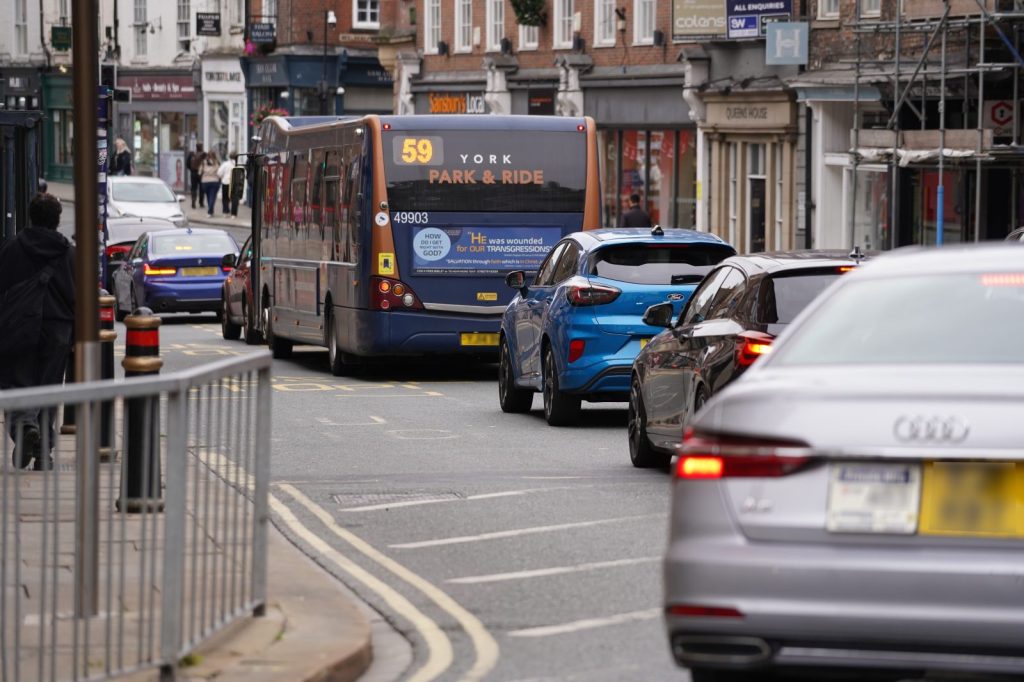
City of York Council held a consultation at the end of 2025 on a scheme to improve bus journeys into and across the city centre, but which will also bring huge benefits to those who cycle, or wish they could cycle, from Clifford Street right through the Micklegate area.
The Rougier Route proposals will introduce a bus-gate on a 90m stretch of Micklegate between the junctions with George Hudson Street (Pop World) and North Street (Sainsburys), allowing only buses, cycles, and emergency vehicles to pass between these two junctions.
All other streets in the Micklegate area will be fully accessible to all road users at all times of day around a new one-way route for motor traffic up Tanner Row and down Micklegate. A contraflow cycle track will allow cyclists to travel in both directions on both streets.
The Campaign submitted the follow response to the consultation.
York Cycle Campaign welcomes the council’s proposal to introduce a bus gate on Micklegate alongside adjustments to traffic flows in the wider Micklegate area, recognising the benefits this will bring to public transport use within the city centre in response to public responses to the Local Transport Strategy consultation.
As Micklegate forms a major gateway for cyclists travelling to the city centre from the western and southwestern areas of the city, our view is the co-benefits for cycling brought about as part of the proposals will significantly improve the safety of the route and increase its attractiveness for less confident cyclists. The benefits will be most greatly perceived by those who are less confident cycling and those who are more vulnerable.
Timing of the closure
The campaign’s position is that the proposal for the restrictions of the bus gate being in place 24 hours a day, seven days a week. Having restrictions run all day, every day, introduces a simplicity to the scheme which will see greater compliance and avoid motorists incorrectly using the corridor due to confusion on operating hours. It also means that cyclists will know the route is safe to use regardless of time of day.
If the closure is to be subject to hours of operation,we believe the hours should be increased beyond 0800 to 1800 as suggested in the consultation so as to benefit early and late commuters.
20mph Speed Limits
The campaign would support the introduction of 20mph speed limits in the corridor, and believe that they should be implemented from the onset. Extending the existing 20mph limit already covering most of Bishophill would help to support Micklegate becoming a safer and vibrant hospitality focussed street.
Imposing a 20mph speed limit will assist in increasing safety for vulnerable road users without causing significant issues to the travel times of motorists, as vehicle speeds in this part of the city are generally low due to the nature of the streets.
As there are sections of the proposed contraflow consisting of advisory lanes a 20mph would be required to remain in line with LTN 1/20 guidance (para. 6.4.23).
Toft Green/Micklegate One-way Loop
The campaign supports the implementation of a one-way loop around Toft Green and Micklegate, subject to the implementation of contraflow cycle lanes and tracks at least to the level shown in the consulted drawings.
The direction of loop and location of contraflow lanes as proposed is preferred to the reverse direction, as along Micklegate it ensures the cycle lane on the side of the road with the least busy footpath, minimising the issues of step out by pedestrians.
Technical Comments on GA Proposals
Having reviewed the proposed general arrangement drawings made available for consultation, the campaign has additional comments on the technical implementation of the scheme as follows.
Tanner Row
A short section of wand type bollards should be provided at the end of the cycle contraflow at the junction of Tanner Row with North Street, similar in application to bollards installed at the end of the contraflow on Coppergate. This will increase the visibility of the contraflow and offer protection to cyclists by preventing vehicles making a wide turn into the junction. This is also recommended in LTN 1/20 (para. 6.4.23).
To alert pedestrians to the fact there is a cycle contraflow, road markings indicating ‘Look Both Ways’ as a variation of diagram 1029 should be included at the dropped crossings on the Tanner Row and North Street junction.
Toft Green
There is a potential conflict between the proposed loading bay and the contraflow cycle track, with the risk of delivery vehicles pulling too far into the bay and obstructing the track with the vehicle or unloaded goods. Applying a colour to the lane through the section would assist identification to delivery drivers and also alert cyclists to potential danger through this section. A short height 25mm kerb face between the loading bay and cycle lane, maintaining the line of the buffer would further highlight the limits whilst not impeding deliveries by trolleys/sack barrows.
No dimensions are given for the kerbed buffer between the parking bays and the cycle track, but the campaign would expect to see at least 500mm as recommended in LTN 1/20 (para. 6.2.42).
Micklegate
The campaign has concerns that the hatched areas will be ineffective against vehicles stopping for loading/unloading, and that vehicles doing so will cause a pinch point for traffic against the oncoming cycle lane. We consider it would be preferable to either build-up this area at footpath level, with potential that this reclaimed street space could be used for additional cycle parking or outdoor seating benefiting businesses on Micklegate. Wand bollards between the main eastbound traffic lane and westbound cycle lane would also provide protection for cyclists at pinch points where unavoidable.
The proposed GA arrangements show the cycle lane on the initial setted uphill from the George Hudson Street junction to be pushed out closer to the centre of the carriageway by a hatched region. The campaign considers that this space would be better allocated to provide a wider contraflow cycle lane uphill, as the combination of a steep up-hill from a junction up an uneven setted surface means many cyclists take this section at low speed with a wide dynamic kinetic envelope requiring a wider lane than usual.
No reference is made about resurfacing of road surfaces as part of the works, however the scheme presents an opportunity to relay the setts to provide a smoother and more comfortable surface alongside other works required to realise the scheme. The campaign recognises the contribution they make to the Micklegate conservation area’s character, but a relaying as like for like but smooth would not detract from this character.
Micklegate Bar
The new arrangement to the western side of Micklegate Bar will hopefully reduce illegal westbound use of the bar by motor vehicles. However there are concerns about safety around vehicles accessing and exiting the proposed loading bay.
The natural manoeuvre into the bay from the junction would be turning right out of Bar Lane forwards into the bay, and then attempting a reversing manoeuvre back into the junction to return down Micklegate. This reversing manoeuvre will present significant risks to westbound cyclists passing the loading bay which will fall in blind spot of vehicles, particularly by LCVs and HGV. Further development of the proposals to make reversing into the loading bay having come through the Micklegate Bar, or having turned left out of Bar Lane, so that existing the bay is done in a forwards motion becomes the natural and only permitted manoeuvre should be made.
Bishophill Senior, Bishophill Junior, Fetter Lane, and Trinity Lane
The one way arrangements on Bishophill Junior and Bishophill Senior, and proposed bollards between Fetter Lane and Trinity Lane don’t make exceptions for cyclists unlike all other proposed one way routes in the scheme. As set out in LTN 1/20 there should be a general presumption in favour of two way cycling on one way streets (para 6.4.21). As these roads have exceptionally low levels of traffic and there is sufficient space contraflows should be provided and can be done so without continuous markings as set out in LTN 1/20 chapter 7.
 York Cycle Campaign
Leave a comment