

The March 2024 newsletter included a link to a survey asking readers about their experiences of cycling during the wet winter of 2023-24. The write-up is in two parts. Part I focused on safety. This is the second half: participants’ suggestions for counteracting the flooding and enabling people to make the journeys they need and want to.
Many people who cycle appreciate the connection with where they are riding, the social interactions, and even the weather. In my experience, cyclists care about their communities and are observant. That’s why I asked: “Can you think of ways City of York Council and other land owners such as Sustrans could mitigate the flooding, or keep walking and cycling routes open, or help people to keep moving without using a car?” I wasn’t disappointed: 14 of the 18 participants responded.
Neo provided as comprehensive a reply as it’s possible to get in a text box with a modest character limit.
They chose ‘Yes’ and said: “This is a huge question. The huge question. Flooding can’t be dealt with just by building higher defences – there has to be a ‘slow the flow’ programme that addresses the problems in the catchment area that results in the huge amount of water that rapidly ends up in York from the Dales; river path routes are going to be flooded – keeping them open isn’t an option – what needs to be done is the reduction of traffic in York and provision of safe joined up cycle routes across the city that are useable when the river path is inaccessible. Less traffic would also help bus reliability and journey times making that a more feasible prospect for those not wanting to, or able to, cycle or walk.”
Cycling Mum said, ‘Yes’ and suggested: “On some routes, the level of tarmac needs to be raised and stability of becks and drainage channels need to be better maintained”. Perhaps she was one of the very many people who use the Millennium Bridge. This winter, as in previous years, high water cut off the Bridge from Butcher Terrace. ‘Heather’ said her route to work was over the Bridge. Her suggestion was: “Raise access path from Butcher Terrace to Millennium Bridge.”
RS2 agrees. They wrote: “Raise approaches to the Millennium Bridge to prevent flood water obstructing access.”
Sarah (mum and commuter) echoed this need. But she also noted that puddling or water incursion on small areas can make a whole route difficult to use or even completely unusable. She wrote: “Some of it is due to drainage or some small sections that get flooded that block the whole route, if these sections were remedied that would help. Need to focus on main routes such as Millennium Bridge or routes where the alternative is a dangerous road.”

‘York cyclist for fifty years with no car’ echoed NEO with a call for a safe infrastructure with no gaps in the network: “We need protected dedicated cycle areas on main arterial roads, especially Fulford road and Fishergate, Bootham and Clifton”.
‘Anonymous’ singled out New Walk for works: “Either raise the riverside path (i.e. New Walk)” but also suggested: “build a dyke”. His/her third suggestion echoed that of others “or make the main road safe with cycleways”.
Dom’s request was for the riverside route on other side of the Ouse: “On my commute, a proper plan for the riverside path from Water End would help enormously.”

unpleasant, unsafe alternatives [Credit: Rebba/Cyclestreets]
John also called for action on the western side of the Ouse though further south: “Raise path on Butcher Terrace side of Millennium Bridge.” And clearly has experiences of having to use the roads instead: “Also cycling from Tower Street or Skeldergate Bridge towards Fulford using Castle Mills Bridge/Fishergate Postern/Fishergate gyratory is much more dangerous than Tower Gardens and New Walk.”
Chris also gave a comprehensive response and stated a need for safer river crossings: “Upstream of York: designate areas as floodplains, plant more trees, reinstate bends in rivers and allow them to follow their natural course, allow more vegetation to grow at river edge, beavers. Clean cycle paths from mud/silt sooner after flooding subsides. Make alternative river crossing routes when Millennium Bridge area is flooded safer for cyclists, especially Skeldergate Bridge and Fishergate gyratory.”
JS underlined the need for safe alternatives that link all parts of the city: “Provision of safe alternative cross-city cycle route when the main riverside routes are flooded. By making a safe route along Shipton Road, Clifton Green and Bootham, on through the centre to Piccadilly or Walmgate.”
Tom was succinct: “More cycle lanes on routes that aren’t susceptible to flooding.” While RN7 said: “Rebuild cycle routes to be higher than any parallel motor vehicle lanes.”
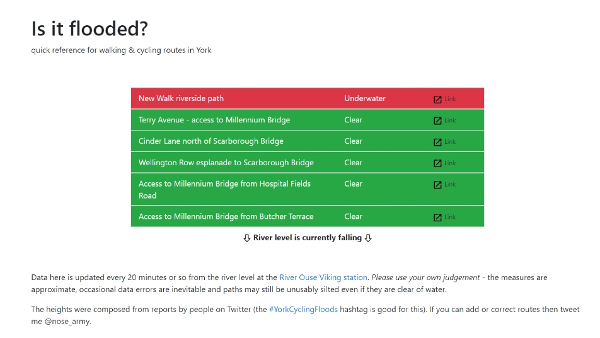
Heather uses the Is It Flooded? site before setting out. A Cycle Campaign member devised this to give an indication if a riverside route is under water. It does note “paths may still be unusably silted even if they are clear of water”.
Stewart focused on the need for post-flooding maintenance: “OK so we can’t stop all the floods but cleaning of river paths after flooding would make things more accessible!”
Andrew suggested using technology to help cyclists make the journeys they want and need to: “Better information on whether roads were passable – webcams in commonly flooded places?” This dovetails with the idea from RebbaYell: “Create a website on which all roads and routes round the city appear and which is updated daily to show routes that are clear of water and clear of mud.”
The responses showed examples of the types of journey people are making and also how important cycling is to them. Anonymous replied to Q6 “Did the flooding prevent you from doing essential daily tasks?” with: “Leisure cycles along the riverside.” Anonymous also highlighted an economic effect of routes being unusable. S/he said: “I now avoid the riverside in times of flood, which is bad for businesses and my enjoyment.” While the reply of Sarah (Mum and commuter) showed route closures due to flooding or the aftermath show it’s not just adults or individuals who are affected. She chose ‘Other’ and said, “Taking my young child to activities such as the railway museum”.

to be safe for all to use [Credit: Rebba/Cyclestreets]
The flooding during the winter of 2023-24 caused disruption for countless cyclists. Thirteen respondents said: “I cycled, but on alternative routes.” Some said they cycled less or a lot less. Three people said they used the car instead. Yet City of York Council anticipates the Local Transport Plan could increase active travel journeys by 20 per cent. How is this to be achieved? RN7 provided a response that will work for cyclists of all ages, and year-round: “Where necessary, remove the motor vehicle lanes.” Cycle campaigners have been asking for reallocation of road space for decades. This would help keep York’s cyclists moving and prevent further inundation… by motor vehicles.
 York Cycle Campaign
Leave a comment