
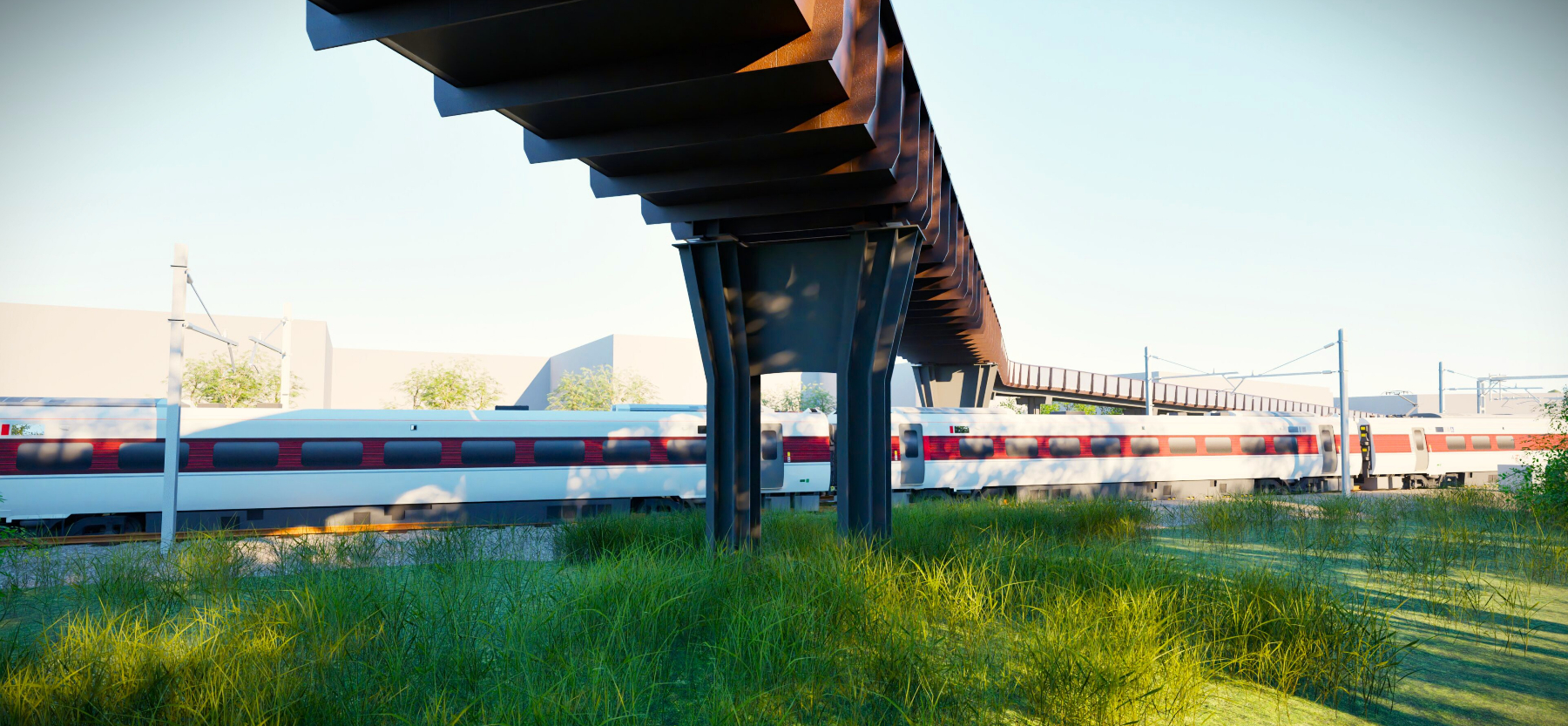
When plans were first announced to replace the restrictive old Wilton Rise footbridge with a modern, step-free crossing, we were thrilled. As we shared in our previous posts, an accessible bridge here will significantly cut journey times and offer a much safer alternative to navigating the hostile traffic on Holgate Road and Blossom Street.
However, following a brand-new design package submitted by the applicant at the end of April, we have made the difficult decision to change our stance from ‘support’ to ‘objection’.
While we welcome the developer’s proactive choice to expand the middle stair landing to reduce congestion, the newly introduced “soft segregation” layout—which uses a simple painted white line to separate walking and cycling spaces—creates critical design and safety flaws. We aren’t alone in these concerns, either; the council’s own Highways department has also responded to the application, stating:
“The available width on the bridge deck is not sufficient to adequately segregate pedestrians and cyclists due to the proximity of the parapets. This will result in cyclists and pedestrians having to go over the line proposed for segregation.”
The Illusion of Width
The developers are advertising a 4.0-metre-wide bridge deck, but splitting it with a fixed white line actually creates an incredibly tight space for both user groups:
- Unusable Footways: The footway width is just 1.5m wide well below the recommended 2.0m, mandated by British Standard and the DfT’s Inclusive Mobility guidance, which allows two wheelchairs, mobility scooters, or prams can safely pass each other.
- Constrained Cycle Lanes: The cycle lane is similarly compressed, leaving an effective width of just 2.0 metres after accounting for the bridge walls. National standards rule this acceptable only for extremely quiet, low-use routes—not for a major, flagship commuter artery feeding directly into the York Central redevelopment and creating a major network link into the city centre for the west.
Increased Danger of Conflict
Instead of protecting users, this layout actively increases the risk of conflict. National cycling design guidance (LTN 1/20) explicitly warns against using painted white lines to split pedestrians and cyclists, labeling them as “ineffective”.
Pedestrians and cyclists routinely cross over painted lines without realising it. Combined with the fact that cyclists will naturally pick up momentum on the downhill slopes of the bridge, this layout creates an unpredictable and hazardous environment. We already see these exact safety issues all across the city where white lines have been painted on narrow paths.
To make matters worse, the developer’s safety audit assumes cyclists will travel at an artificial, completely unrealistic speed of just 10 km/h (6pmh) on these down-gradients to justify the narrow deck space and blind corners.
What Needs to Change?
We want this bridge project to succeed. It has the potential to match the incredible, transformative impact that the Millennium Bridge brought to south York. But we cannot endorse a brand-new piece of key transport infrastructure that deliberately bakes in substandard dimensions from day one.
If segregation is going to be used, it must be fully compliant with modern safety, accessibility and design standards. In our formal response, we are calling on the applicant to ensure the final design includes:
- Sufficient Width: Widening the deck footprint to safely accommodate peak pedestrian and cycle volumes.
- Distinct Surfacing: Using a clear, color-contrasted surface material so walking and cycling zones are instantly recognisable.
- Frequent Visual Cues: Painting clear layout symbols on the ground at regular 20-metre intervals.
- Realistic Safety Modeling: Re-evaluating visibility and safety calculations using real-world commuter speeds and use numbers.
You can download and read our full, detailed technical response in the document here. You can learn more about the application and submit a response of your own on the council’s planning portal page, searching for the application reference 25/02252/FUL.
Do you care about safe, accessible and convenient infrastructure?
We regularly contact our members asking for their opinions and experiences of cycling in York when responding to council consultations and queries. We also rely on our volunteers to help with producing all our responses.

Leave a Reply